Choosing an ecommerce platform affects more than your launch date. It shapes how you take payments, sell subscriptions, manage customers, and maintain your store after the first order arrives.
If you are comparing SureCart vs WooCommerce vs Shopify in 2026, our recommendation is to start with SureCart for a WordPress-based business that wants built-in selling tools and a practical path from launch to growth. WooCommerce deserves a look when extensive customization drives the project. Shopify deserves a look when a hosted storefront and connected retail operations are the priority.
The right choice starts with your business model. Here is how the three platforms compare—and why SureCart earns the first demo for many creators, service businesses, and client websites.
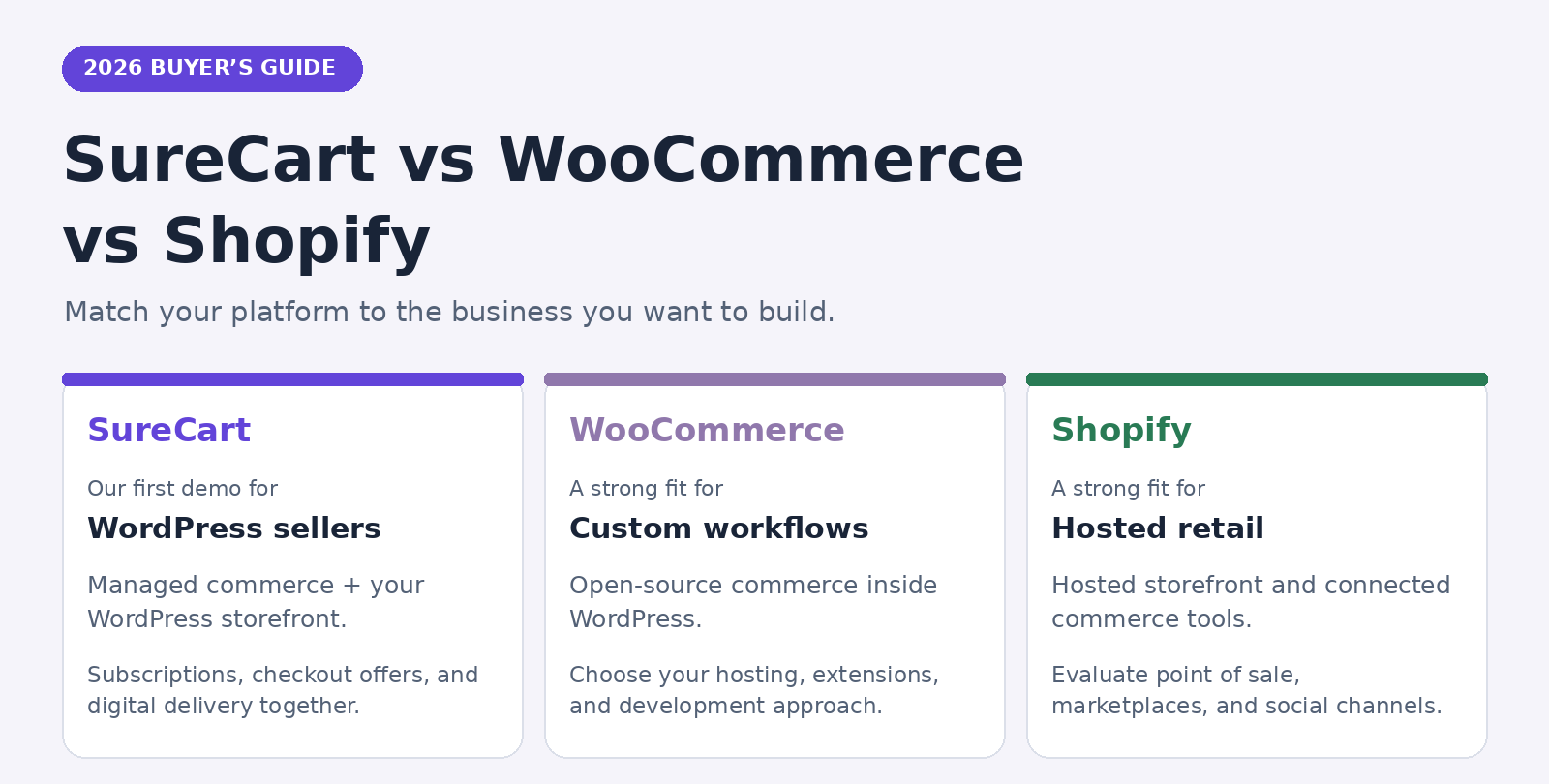
SureCart vs WooCommerce vs Shopify: comparison at a glance
| What matters | SureCart | WooCommerce | Shopify |
|---|---|---|---|
| Platform model | WordPress storefront with managed commerce services | Open-source ecommerce for WordPress | Hosted commerce platform |
| Main reason to shortlist it | Integrated selling tools in a WordPress workflow | Extensive control and customization | Hosted store and connected sales channels |
| WordPress site hosting | Budget separately | Budget separately | Store hosting included in the platform plan |
| Subscriptions | Built-in subscription tools | Available through extensions, including WooCommerce Subscriptions | Available through apps, including free Shopify Subscriptions |
| Digital products | Built-in digital file delivery | Supports digital products | Free Shopify Digital Products app available |
| Checkout offers | Built-in order bumps and post-purchase upsells | Choose suitable extensions or custom work | Choose suitable apps and check plan requirements |
| Who we would recommend it to | WordPress sellers and client projects with standard commerce needs | Businesses with demanding custom workflows | Retailers prioritizing hosted operations and multiple sales channels |
Why SureCart is our first choice for many WordPress stores
1. Sell subscriptions without starting with a separate billing extension
A store selling a downloadable guide today may need a monthly membership tomorrow. That is where SureCart’s built-in subscription tools become useful.
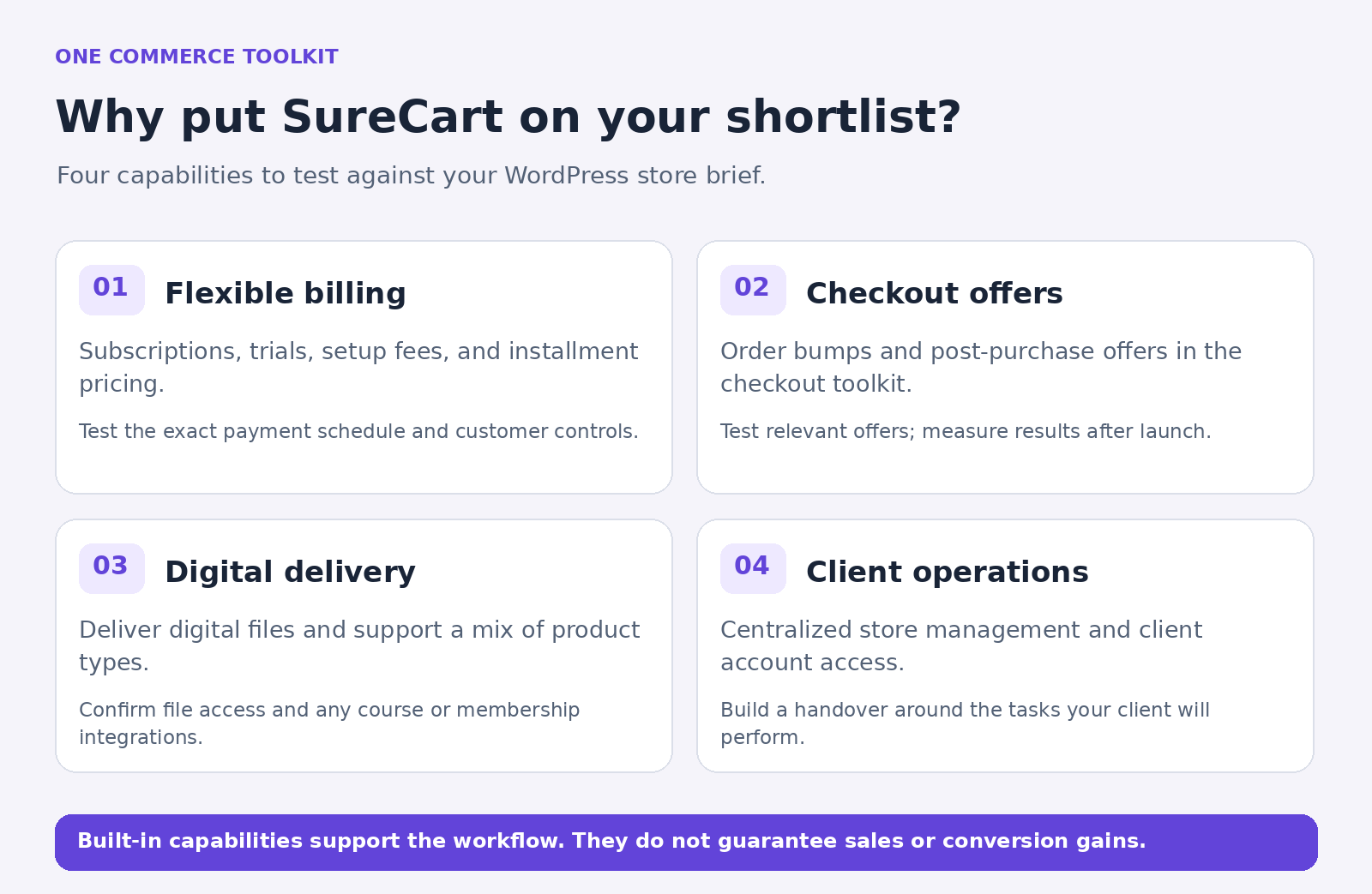
SureCart supports recurring billing, installment schedules, free and paid trials, and setup fees. Its subscription offering also includes customer plan management, payment retries, and retention tools. You can design your offer around how customers want to buy, rather than beginning the project by selecting a separate subscription extension. [12]
Consider a hypothetical coaching business: it wants to sell a one-time workshop, a three-payment package, and a monthly support plan. For that brief, we would demo SureCart first. Test each billing model and access rule before committing, especially if another learning or membership system delivers the product.
The benefit for a client: more of the sales model can be configured within one commerce system, giving the handover a clearer starting point.
2. Build checkout offers around the product you are selling
SureCart’s checkout builder provides visual blocks, customizable fields, and conditional display rules. It also supports order bumps and offers after purchase. For a digital product, the checkout can omit the shipping address block. [13]
Imagine selling a $49 template pack. You could offer a relevant companion resource during checkout, then present an optional implementation session after payment. That is a proposed sales flow, not a forecast: the value depends on relevance, pricing, and how customers respond.
We like this approach because it lets a business test its offer without making the initial launch depend on several separately selected conversion tools. Measure completed checkouts, average order value, refunds, and support requests to judge whether an offer actually helps.
3. Keep the store in your WordPress publishing workflow
SureCart integrates with the WordPress block editor and offers native support for Elementor and Bricks. Its homepage also describes integrations with learning platforms for course sellers. [1]
For a business already using WordPress, that makes SureCart a compelling WooCommerce alternative and an option to evaluate before moving the storefront to another platform. You can build around the content, design tools, and customer journey you already use.
Our recommendation is especially strong when educational articles, service pages, or resources lead readers toward a purchase. Plan the route from useful content to a relevant product, then make the checkout easy to understand.
4. Give clients a manageable store after launch
SureCart lists centralized store management, client accounts, and payment connection links among its agency features.
For a designer or agency, these capabilities are worth testing during the demo. A client should be able to find an order, issue a refund, understand a subscription, and view the information they need without depending on the original developer for every routine task.
That is our practical reason to favor SureCart for suitable client projects: choose a system you can teach, document, and support repeatedly. Confirm the client’s required integrations before making the final recommendation.
Pricing in 2026: compare software fees and the full store budget
A free plugin, an annual commerce plan, and a hosted storefront subscription are different purchases. Compare their listed fees, then add the costs your project actually needs.
| Option | Current listed software fee | Budget context |
|---|---|---|
| SureCart Launch | $0 fixed subscription + 2.9% platform transaction fee | WordPress hosting and processor charges are additional |
| SureCart Pro, one store | $199/year; no SureCart platform transaction fee | WordPress hosting and processor charges are additional |
| WooCommerce core | $0; no platform fee or revenue share | Hosting, selected extensions, and processor charges are additional |
| WooCommerce core + official Subscriptions extension | $279/year for the extension’s one-year plan | One specific subscription setup; other extensions may differ |
| Shopify Basic, billed yearly | $29/month equivalent, or $348/year | Store hosting included; processor charges and optional apps are additional |
| Shopify Basic, billed monthly | $39/month, or $468 across 12 months | Different billing commitment from the yearly option |
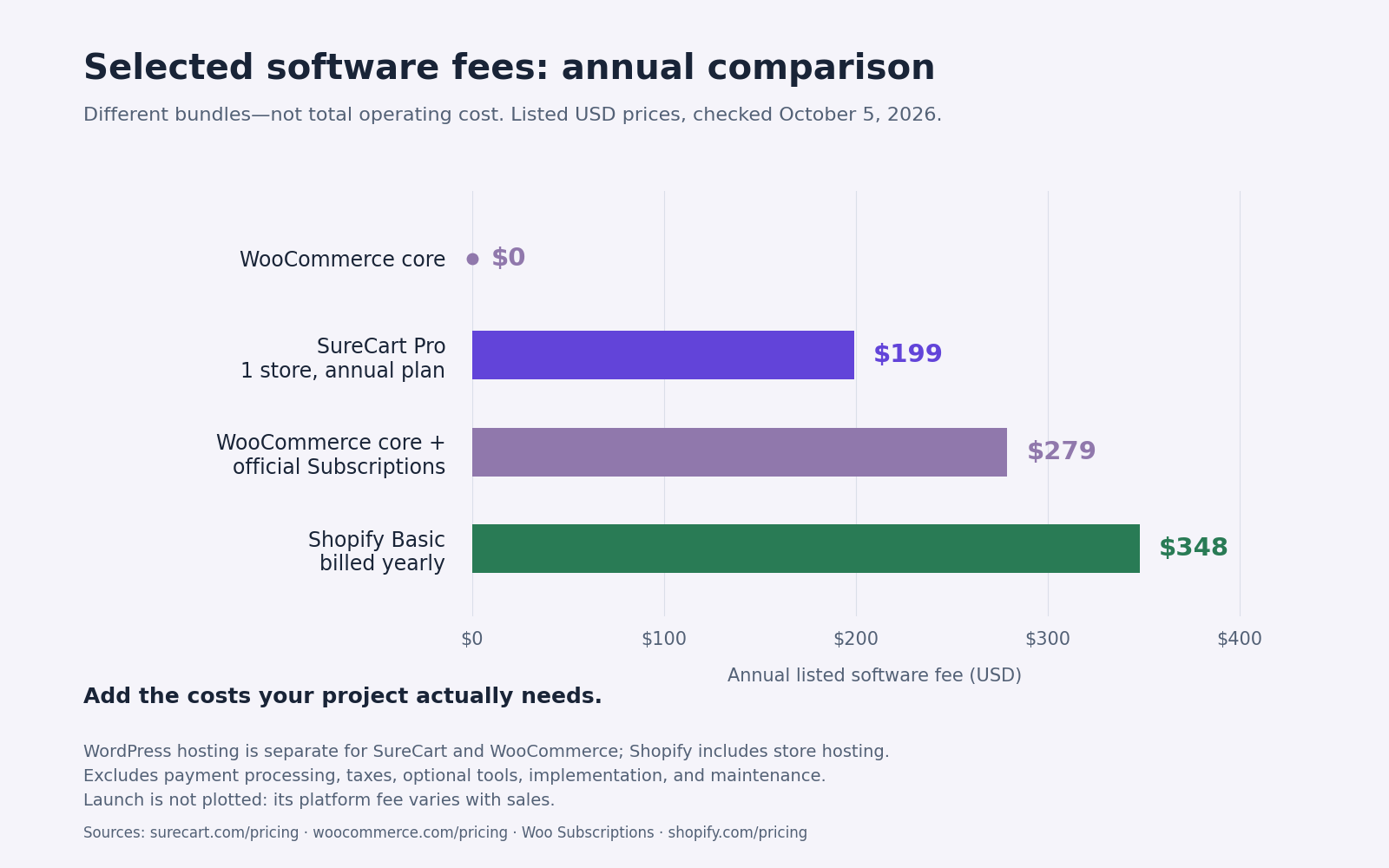
Different bundles, not total operating costs. SureCart Launch is excluded from these bars because its platform fee varies with sales. WordPress hosting, processing, taxes, optional tools, and implementation are excluded. Shopify’s plan includes store hosting.
Where SureCart Pro becomes compelling
At the displayed prices, SureCart Pro is $80 less per year than the official WooCommerce Subscriptions extension alone, and $149 less than Shopify Basic billed yearly. Those are software-fee differences calculated from the table—not guaranteed savings on your whole store.
A simple WooCommerce store using free extensions can have lower software fees. Shopify includes hosting, which matters if you are starting without a website. SureCart becomes particularly attractive when its included capabilities match tools you would otherwise need to source separately.
Build a complete budget that covers software, hosting, payment processing, optional integrations, setup, and ongoing maintenance. For an existing WordPress site, ask your host whether the current plan is suitable rather than assuming hosting is either free or a new expense.
SureCart Launch vs Pro: the break-even calculation
Launch removes a fixed subscription charge, but its 2.9% platform fee is separate from your processor’s charges. Pro removes the SureCart platform fee; it does not eliminate payment processing costs.
Using the current one-store annual Pro price, the fee-only calculation is:
$199 ÷ 0.029 = approximately $6,862 in annual sales subject to the platform fee.
| Annual sales subject to Launch’s fee | Launch platform fee at 2.9% | Annual Pro fee |
|---|---|---|
| $5,000 | $145 | $199 |
| $10,000 | $290 | $199 |
| $25,000 | $725 | $199 |
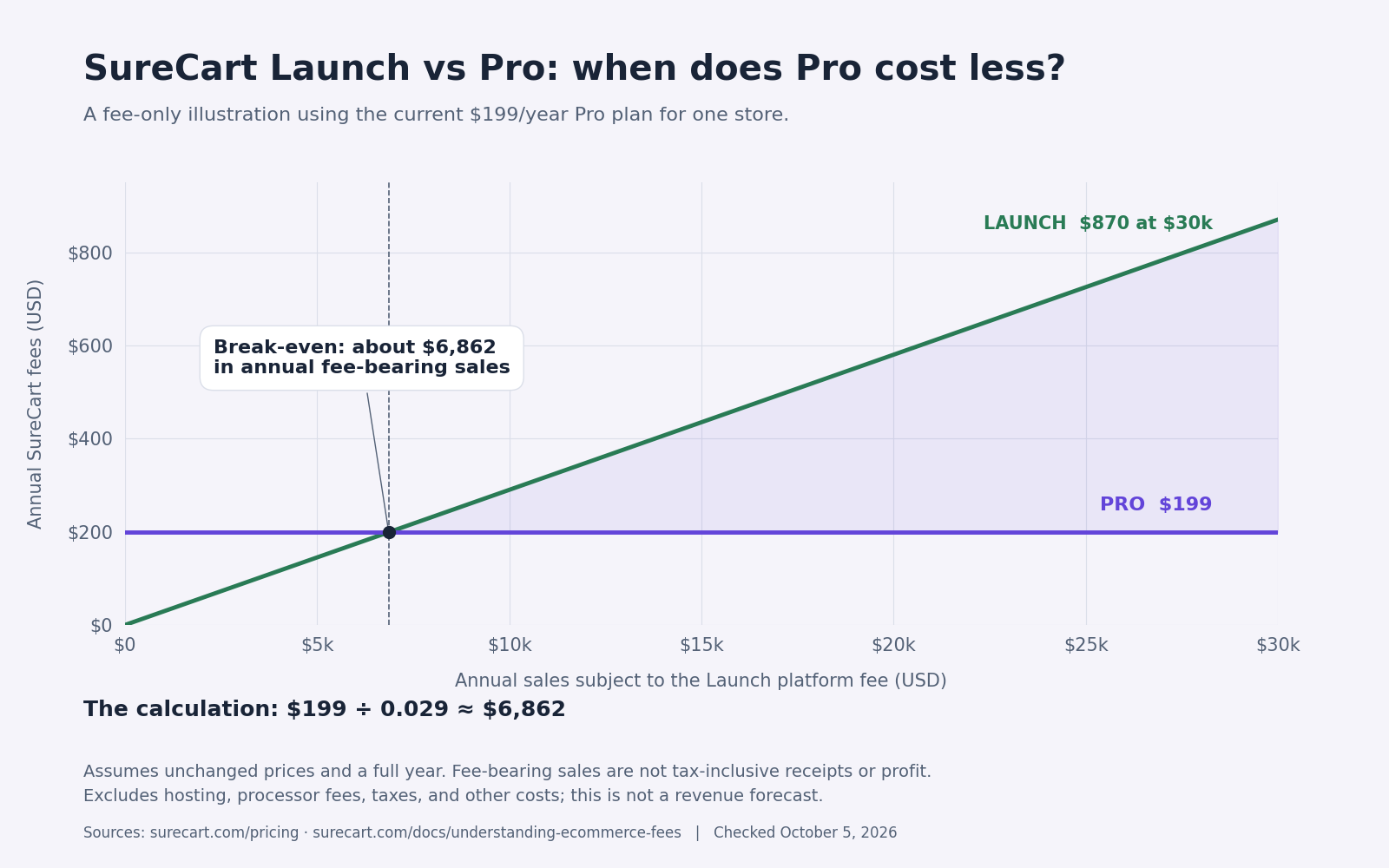
Illustrative calculation using sales subject to the 2.9% fee, not tax-inclusive receipts or profit. Excludes hosting, processor charges, taxes, and other costs. Assumes an unchanged $199 Pro price for a full year.
Launch is a reasonable place to test an offer with uncertain sales. Once projected annual fee-bearing sales pass that threshold, evaluate Pro for lower SureCart fees. Recalculate if the plan price changes.
SureCart vs WooCommerce: integrated tools or extensive customization?
WooCommerce’s homepage emphasizes open-source flexibility and control over hosting, payments, and features. Its ecosystem includes extensions for additional store functionality.
That flexibility matters when the project calls for unusual product rules, a specific existing integration, or custom work that relies on the WooCommerce ecosystem. A capable team may have good reasons to build there.
SureCart’s comparison page describes a different architecture: its commerce services run on SureCart’s infrastructure, while WooCommerce runs within your hosting environment.
Our inference is that SureCart can simplify the commerce portion of a WordPress project when its built-in features meet the brief. Your WordPress site still needs suitable hosting, updates, backups, and care. Managed commerce does not mean the entire website maintains itself.
Choose SureCart first when you want a WordPress store with integrated billing and sales tools. Choose WooCommerce first when a required custom workflow or integration makes its ecosystem essential.
SureCart vs Shopify: WordPress commerce or a hosted retail platform?
Shopify’s homepage presents centralized operations across payments, fulfillment, and retail. Its comparison page highlights point of sale and integrations for social and marketplace selling.
We would prioritize Shopify for a retailer whose main requirement is a hosted store connected to in-person sales and multiple channels. Compare the exact workflows and any additional services needed.
Shopify can also sell subscriptions and digital products. Its first-party Shopify Subscriptions and Shopify Digital Products apps are currently listed as free. It would be misleading to assume every Shopify subscription or download store needs a paid app.
SureCart’s appeal is the combination of WordPress publishing and built-in commerce features. If your site already attracts customers through articles, services, courses, or downloads, we would test SureCart before moving to a hosted storefront.
For payment costs, Shopify Basic lists a 2% third-party transaction fee; check whether that applies to your intended payment setup. That is separate from card processing, and it should not be treated as a charge on every Shopify store.
Which ecommerce platform is best for SEO?
For a business building its content strategy in WordPress, SureCart is our preferred platform to evaluate. It fits the publishing workflow we would use to connect helpful content with relevant offers.
That is a workflow recommendation, not evidence that SureCart automatically outranks WooCommerce or Shopify. Shopify also describes SEO tools on its comparison page.
In practice, give each important product a clear page that explains what it is, who it helps, what it costs, and how delivery works. Link useful buying guides to relevant products. Write descriptive titles and image alt text. Check the mobile experience before launch.
SureCart’s managed architecture is a useful technical distinction, but the reviewed pages do not establish a controlled three-platform speed benchmark. Test your actual site; avoid promising faster rankings or a specific conversion lift based on the platform name alone.
Our recommendation: start with a SureCart demo
For creators, consultants, subscription businesses, and agencies building suitable WordPress stores, SureCart earns our first recommendation in 2026. The reason is concrete: subscription billing, checkout offers, digital delivery, and client-management capabilities can address several common requirements in one commerce product.
Before choosing, run a demo around one real product. Test the price, payment method, confirmation email, delivery or shipping, refund, and customer account. For subscriptions, also test renewal and cancellation. Let the results decide whether the platform fits.
Ready to build an online shop around your WordPress site? Explore SureCart’s features, view the demo store, and compare the current plans. Start with Launch if you want to validate the offer, then evaluate Pro as sales grow.
Frequently asked questions
Is SureCart better than WooCommerce?
We recommend SureCart for WordPress projects that benefit from integrated selling tools and whose requirements it supports. WooCommerce is a strong choice when extensive customization or a specific ecosystem integration is central to the brief.
Is SureCart free?
Launch has no fixed subscription charge, but it includes a 2.9% platform transaction fee. Payment processor charges remain separate. The currently listed one-store Pro annual price is $199 and removes SureCart’s platform transaction fee. [3], [15]
Can SureCart sell physical products?
Yes. SureCart lists physical products, inventory, shipping, and fulfillment features. Test the shipping regions, carriers, and integrations needed for your actual store. [2]
Can Shopify sell subscriptions and digital products?
Yes. Shopify offers first-party subscription and digital-product apps currently listed as free. Check that their capabilities and payment requirements match your business. [11], [14]
Does SureCart replace WordPress hosting?
No. SureCart manages commerce services, while your WordPress website still needs hosting and maintenance. Include those costs when comparing it with Shopify’s hosted-store plans.

